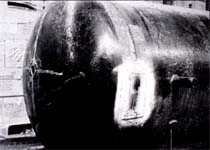
Figure 1.
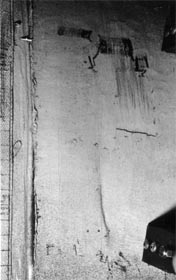
Figure 2.
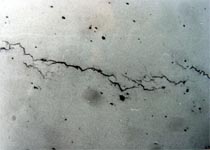
Figure 3.
Background
It is well known that carbon steels can suffer stress corrosion cracking (SCC) in anhydrous ammonia storage vessels, but it is less documented that SCC has also occurred in ambient temperature liquid receivers that are commonly found in refrigeration plants used in the food industry. These vessels are frequently unlagged and located externally where the temperature on the surface may reach 60°
In one particular instance, an 11000 litre ammonia vessel developed a leak in the dished end at a point close to the main circumferential weld as shown in figure 1. The vessel had been in service for approximately 8 years.
Findings
The vessel was removed from service and subjected to a full examination using both destructive and non-destructive techniques, in order to determine the nature and cause of the cracking. The main crack shown in figure 2, measured 40mm in length and was found to have propagated from the inside surface at a distance of approximately 100 mm away from the weld on the shell cylinder section.
A series of ultrasonic scans revealed the presence of numerous other cracks which were generally transverse in orientation to the main welded seams. The magnetic particle examination of the entire inside surface revealed the presence of radial cracking in the shell plate emanating from some of the nozzle openings. The majority of the cracking appeared to be confined to the area of the shell which corresponded to the vapour space rather than below the working liquid level.
A metallurgical examination of the cracking revealed that it was both branched and intergranular which is characteristic of SCC. The micrograph shown in figure 3 illustrates the typical morphology of this type of cracking.
Key Points
- Enspec personnel have been involved with a number of cases relating to SCC in ammonia refrigeration systems, and in some cases, there have been as many as 4 or 5 vessels on one particular site which were affected by this form of corrosion attack.
- Enspec has developed an ultrasonic procedure for the detection of SCC in ammonia vessels while still in operation.
- It is Enspec's experience that in carbon steel vessels utilised in ammonia refrigeration systems, SCC can occur at any point in the life of the vessel.
- In the case of SCC of carbon steels caused by ammonia, it is known that the presence of more than 0.2% water can act as an inhibitor, but that the presence of oxygen increases the risk of cracking. It is important therefore that all steps are taken to remove oxygen from the ammonia system during the initial filling. It is also important to ensure that any non-condensable gases are purged from the system.
Back to Failure Case Histories