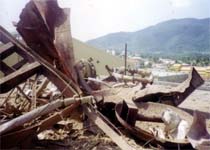
Figure 1.
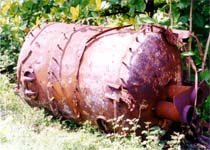
Figure 2.
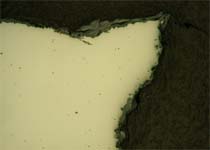
Figure 3.
Background
A catastrophic failure occurred with a deaerator vessel which had been in service for a period of approximately 35 years. The explosion caused considerable damage to the adjacent plant and equipment as shown in figure 1. The vessel was propelled across the roof of the building over a distance of approximately 20 metres.
Findings
The initial examination revealed that the vessel ruptured along one of the longitudinal welds on the underside of the vessel. An on-site examination of the fracture faces showed that the crack initiated in the mid-section of the longitudinal weld. It then continued to propagate along the full length of the vessel and around the dished end circumferential welds. The vessel shell was almost flattened completely with one of the dished ends becoming detached. The other dished end remained attached to the flat cylindrical section by a relatively short section of plate. The spray chamber had also become completely detached from the top of the vessel (figure 2).
The shell plates showed signs of localised pitting corrosion on the internal surfaces together with a more general form of corrosion on the outside surface. The insulation material was found to be in a poor condition and there was evidence of water hold-up between the shell outer surface and the insulation.
A metallurgical examination revealed evidence of an oxide layer on the surface of the fracture face as shown in figure 3. The presence of the oxide on the tip of the crack indicated that the vessel had probably been leaking for some time.
Unfortunately, because of the amount of damage caused to the control system together with the limited amount of information that was available at the time of the failure, it was not possible to determine whether sudden overpressurisation was responsible for the rupture. The evidence suggests that the vessel failed by a mechanism known as "fast ductile tearing".
Key Points
- Deaerator vessels have a history of premature failure due to either corrosion or corrosion fatigue. A survey of 75 deaerators carried out by a UK insurance firm [1] revealed that six in ten of the vessels exhibited some form of corrosion-related degradation. It has been Enspec's experience that deaerators need to be inspected internally on a regular basis for signs of corrosion pitting and/or corrosion fatigue cracking.
- The most effective non-destructive test method for the detection of cracking in the region of the welds and adjacent shell section is wet fluorescent magnetic particle testing. This is a particularly effective crack detection method which is particularly suitable for the low-light conditions inside a vessel. It also does not require any form of surface cleaning or mechanical treatment on the metal surface other than the removal of any loosely-adhering corrosion deposits prior to testing.
[1] Bolten, J.G., Jansse. L.W., "Why are de-aerators cracking up?" Process Engineering Jan 1987, pp - 37 - 39.
Back to Failure Case Histories