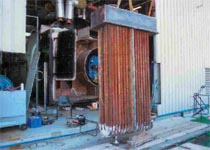
Figure 1.
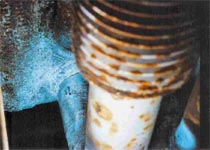
Figure 2.
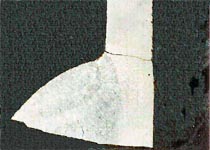
Figure 3.
Background
As part of a modernisation project, a factory installed three new firetube boilers designed to operate at 15 bar. Because the boilerhouse was located some distance from the process plant and to provide the required steam temperature, the boilers were supplied with smokebox superheaters as shown in figure 1. After about 18 months of operation, one of the superheaters was found to be leaking. The boiler fabricator carried out a magnetic particle test of the tube to header welds. The cracking was located at the toe of a fillet weld between one of the vertical tubes and the bottom header as shown in figure 2. There were indications of a second crack that had not propagated through the wall thickness and had not leaked.
Findings
When the second boiler was shutdown, Enspec was requested to inspect the boiler and the superheater. As access was extremely limited to the welds on the superheater, the decision was taken to remove the unit so that a complete inspection could be carried out on the bottom header. A subsequent pressure test revealed several other cracks. A magnetic particle test revealed a number of cracks which had initiated from the external surface but were not yet leaking. All of the cracks were in a similar position at the "toe" of the fillet weld between the vertical tubes and the bottom header. Since there were so many cracks at the bottom of the superheater, concern was raised about the condition of the top header. The top header could not be inspected as it was inaccessible because of the superheater support structure.
Once the support structure had been removed, a full magnetic particle test showed that there were seven cracks in the bottom header and six cracks in the top header. One of the most severely cracked junctions was removed for metallurgical examination. This indicated that the cracking was caused by thermal fatigue. Figure 3 shows a mounted cross-section of the weld with a crack emanating from the "toe" of the weld to tube fusion boundary. However, to account for the cracking in a relatively short time, it was necessary to determine the root cause of the thermal cycling. A series of thermocouples were fitted to several locations on the superheater in order to monitor its thermal profile in service. The data showed that the superheaters were subjected to an unexpectedly high number of thermal cycles. The underlying causes leading to this situation were due to a combination of factors which were identified.
Key Point
- The investigation showed that the premature failure of welds generally in boilers requires careful investigation, as it may not necessarily be a consequence of poor fabrication.
Back to Failure Case Histories