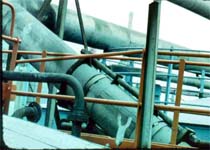
Figure 1.
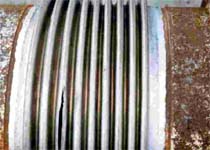
Figure 2.
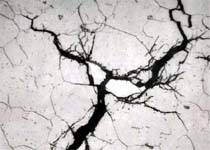
Figure 3.
Background
A sudden major failure occurred with an alloy 825 bellows that was located in a high pressure steam main. The steam main carried steam at 20 bar from a boiler house on one side of a river to the main manufacturing facilities on the opposite side of the river. Since the steam main was close to the bridge that people used to cross the river, the failure could have had very serious safety implications. The layout of a similar bellows in the same steam main is shown in figure 1 where it had been installed in an inclined position.
Findings
It was observed that a large crack had formed on the crown of one the convolutions of the bellows as shown in figure 2. The crack was in the lower section of the bellows.
The bellows was subsequently subjected to a metallurgical analysis. Visual examination of the surfaces revealed the presence of a white deposit in some of the convolutions. The white deposit was determined to be alkaline with a similar composition that was consistent with boiler feed water that had evaporated. This is indicated that priming had occurred at some in the boiler which had resulted in the carryover of some of the boiler water. The bellows had not been fitted with an internal deflector to minimise the build-up of any deposits in the bellows.
Sections of the bellows at the point of fracture were taken and prepared for microscopical analysis. The micrograph shown in figure 3 illustrates that the cracking was intergranular, typical of stress corrosion cracking (SCC). It is known that nickel alloys such as alloy 825 are susceptible to SCC in the presence of sodium hydroxide. The susceptibility of any nickel based alloy is determined by the temperature and caustic concentration.
It was therefore concluded that the boiler water that entered the steam main due to priming, had settled in the convolutions of the bellows and later evaporated. The investigation showed that the combination of conditions of caustic concentration and temperature had been suitable for SCC to occur. A subsequent stress analysis by a third party showed that the bellows were in fact not necessary and they were replaced by straight sections of pipework
Key Point
- When designing steam distribution systems, consideration should be given to the configuration of the pipework to prevent liquid traps. Concentration mechanisms can occur especially under evaporative conditions, the presence of which can compromise the structural integrity of tube material.
Back to Failure Case Histories