Figure 1.
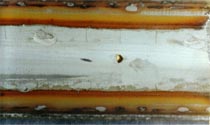
Figure 2.
Background
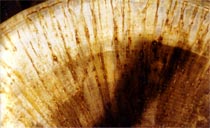
A stainless steel jacketed process vessel began to develop pitting and localised rust staining on the inside surface around the region of the bottom dish (figure 1). At the same time, a series of leaks began to develop in the biobore drainage pipe below the vessel as shown in figure 2.
Findings
An internal examination of the vessel indicated that the pitting was very localised and that it was also associated with corrosion deposits. The depth of the pitting was found to vary between 0.5 and 1.5mm deep.
An examination of the failed horizontal section of biobore pipe revealed evidence of severe pitting and etching of the metal below the liquid level. It was also evident that although there were a number of smaller pits above the liquid level in the vapour space, the majority of the corrosion attack had occurred below the liquid level. The extent and appearance of the corrosion attack was such that it indicated that the pipe did not drain properly resulting in liquid entrapment.
A metallurgical examination of the failed section of pipe revealed the corrosion was a form of chloride-induced pitting which had developed within a relatively short period of time. Other than the presence of micropits on the surface, the metal did not exhibit any unusual metallurgical features.
The investigation showed that the presence of chloride ions in the acidic process environment was primarily responsible for the initiation of the corrosion damage. The source of the chlorides however was not identified.
Key Point
- Chloride-induced pitting corrosion of the austenitic grades of stainless steel is a relatively common problem, which can generally only be overcome by either eliminating the chlorides from the environment or, selecting an alternative material of construction.
Back to Failure Case Histories