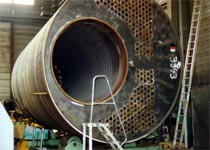
Figure 1.
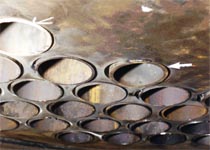
Figure 2.
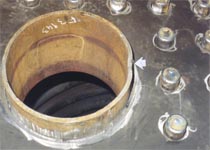
Figure 3.
Background
A leading European boiler manufacturer was commissioned to manufacture a new 25000 Kg/hr firetube boiler for an overseas oil refining facility (figure 1). It was a replacement unit for one which had suffered thermal fatigue cracking and water side corrosion.
Enspec was commissioned to perform a Manufacturing Quality Inspection (MQI) of the boiler on the behalf of the client. The main objective of the inspection was to ensure the quality of the as-built construction was in conformance with the design code. As the manufacturer was an experienced leading supplier of steam boilers, it was considered that in this case, only one MQI would be necessary during construction.
Findings
The MQI was carried out at a relatively early stage of fabrication, in order to ensure that any defects, manufacturing deficiencies or non-conformities could be rectified without any major impact on the construction schedule.
The inspection revealed two areas of concern, one of which required immediate rectification before construction could proceed any further i.e.
- Incorrectly fitted smoke tubes which resulted in both the under-protrusion and over-protrusion of the tube ends in the reversal chamber tube plate as shown in figure 2. Out of a total of 116 tubes, 24 tubes were found to have been installed incorrectly and were therefore rejected. The main reason for incorrect fit-up of the smoke tubes was that the tube ends had not been cut square and, that they had been cut to the wrong length. This resulted in an improper weld profile that would have led to the premature failure of the welds.
- Mechanical damage on the outer edge of the reversal chamber access tube (figure 3).
Key Point
- Even though the fabrication and inspection requirements for fired pressure vessels are covered by the construction code, the main emphasis is placed on the quality of the main structural welds rather than less critical welds such as the smoke tube welds. Experience has shown that fatigue failures resulting from pre-existing welding defects in these welds regularly occur. The independent inspections carried out by Enspec are designed to detect fabrication non-conformities, the presence of which could compromise the operational reliability of the equipment.